
The call usually comes from one of the kids. “Mom toured a place near Doylestown last weekend and she loved it. They have an apartment opening up in the spring. Where do we even start?” Sometimes it’s Dad in Newtown deciding the stairs have won, or a family in Quakertown whose plans changed overnight after a fall. Every one of these moves is a little different, but the families who feel calm on move day almost always have one thing in common: a timeline.
We help families move parents into senior living all over Bucks County, from Quakertown and Perkasie in Upper Bucks, to Doylestown, Chalfont and New Hope in Central Bucks, to Newtown, Yardley, Langhorne, Richboro, Levittown, Bensalem and Southampton in Lower Bucks. This is the month-by-month plan we’d hand our own family, from the first tour to the first week in the new apartment, plus what to do when you don’t have months to plan.
You’re far from the only family doing this
Bucks County is getting older, and the numbers show it. According to the U.S. Census Bureau’s American Community Survey, about 20.5% of Bucks County residents were 65 or older in the 2020 to 2024 estimates, compared with 19.5% statewide and 17.2% nationally. That’s an estimated 132,986 people, about 35,000 more than in the 2010 to 2014 estimates.
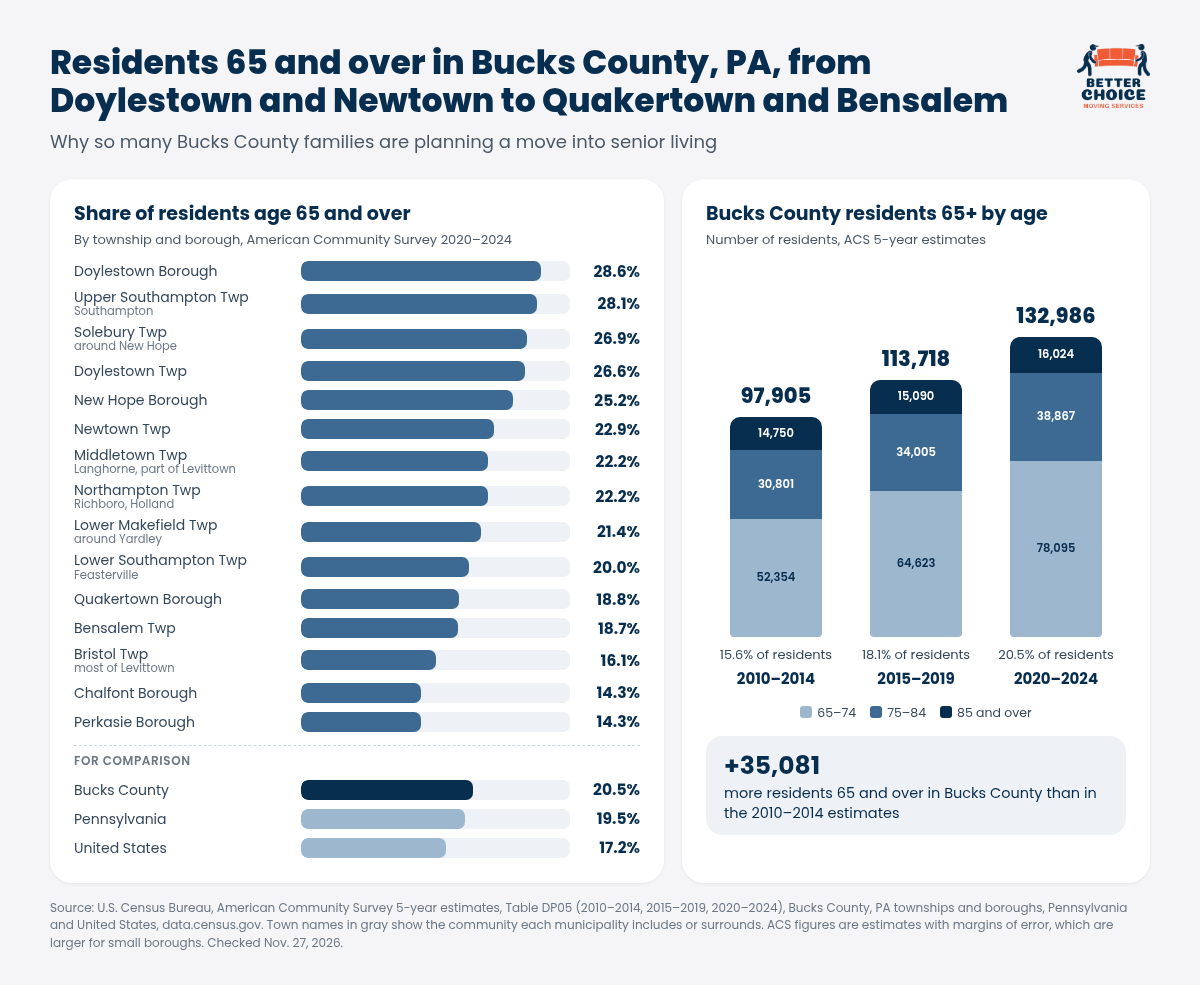
- Central Bucks skews older. About 28.6% of Doylestown Borough residents are 65 or older, along with 26.6% in Doylestown Township, 26.9% in Solebury Township around New Hope and 28.1% in Upper Southampton.
- Lower Bucks is close behind. Newtown Township (22.9%), Middletown Township around Langhorne (22.2%), Northampton Township around Richboro (22.2%) and Lower Makefield around Yardley (21.4%) are all above the county average.
- The 75-and-over group is growing too. The county had an estimated 54,891 residents age 75 and over in 2020 to 2024, up from 45,551 in 2010 to 2014. That’s the age when many of the families we meet start looking at independent living, personal care or assisted living.
In other words, there are a lot of Bucks County families having the same kitchen-table conversation you are, and a lot of neighbors who have been through it and can tell you how it went.
First, know which kind of senior living you’re moving into
The type of community shapes almost every step of the timeline, from how much furniture fits to how much paperwork comes before move day. In plain English:
- 55+ communities are neighborhoods of homes, townhomes or condos for active adults. The move works much like any home move, with HOA rules on top.
- Independent living is usually apartment-style, with meals, activities and transportation built in. Expect smaller rooms, elevators and set move-in hours.
- Personal care homes and assisted living residences help with daily tasks like bathing, dressing and medications. In Pennsylvania, both are licensed and inspected by the Department of Human Services, and you can look up any home’s license and inspection reports in the state’s Human Services Provider Directory. Rooms are often the smallest of all, so the “what comes along” list gets short.
- Continuing care retirement communities (CCRCs) offer several levels of living on one campus, and in Pennsylvania a provider needs a certificate of authority from the Insurance Department and must give you a disclosure statement, with a seven-day window to change your mind after you sign or pay the deposit.
We went deeper on the differences, the Pennsylvania rules and the floor-plan math in our guide to moving into a 55+ community. The same rules apply on the Bucks County side. If you’re still figuring out what level of help fits, the Bucks County Area Agency on Aging in Doylestown offers information and referral, care management and caregiver support for older adults and their families.
The family moving timeline
Here’s how we’d lay out a move into senior living when you have a few months. If your timeline is shorter, skip ahead to the section on fast moves. Nothing here is a hard rule. Move steps around to fit your family.
3 to 6 months out: the conversation and the tours
- Let your parent lead where you can. The move goes better when it feels like their decision. Ask what matters most to them: being near the grandkids in Yardley, staying close to their church in Perkasie, a walkable town like Doylestown or New Hope, or a dining room where they’ll see friends every night.
- Tour more than once. The Pennsylvania Department of Human Services suggests visiting personal care and assisted living homes several times, at different times of day, and watching how staff talk with residents. That advice works for any community.
- Ask for the floor plan with measurements for the exact apartment or model, not just the brochure version. It drives every decision that follows.
- Get the move-in rules in writing. Move-in days and hours, elevator and loading dock reservations, where the truck parks, and whether the community needs a certificate of insurance from the mover.
- Start the money and house questions early. Will the house be sold before or after the move? Does the community need a deposit by a certain date? A real estate agent and a financial advisor or elder law attorney can help with this part. It sets the calendar for everything else.
8 to 12 weeks out: the floor plan and the “yes” list
- Measure the favorites first. The bed, the recliner, the dresser, the kitchen table. Put a piece of painter’s tape on each one with its width, depth and height.
- Sketch the new rooms. Graph paper and paper cutouts work well. Leave clear paths for a walker or cane, now or later, and a straight line from the bed to the bathroom.
- Make the “yes” list. Everything that fits the plan and matters to your parent. This is the list the movers work from, so the rest of the house can be sorted without guilt.
- Talk to the family about heirlooms. Who wants the hutch, the piano, the cedar chest, Grandpa’s tools? Write it down. It saves a lot of hard conversations later.
6 to 8 weeks out: sort the rest of the house
- Work room by room, a few hours at a time. Long sorting days wear everyone out, especially the person who has lived with these things for forty years. Short sessions over several weekends are kinder.
- Use four piles: coming along, family, donate, and store for now. Our guide to helping a parent downsize walks through this step in detail.
- Plan for what’s left. Furniture nobody wants, old mattresses and the last of the basement can go with our haul-away service, where we donate what we can.
- Know what can’t ride on the truck. Paint, propane, gasoline and other hazardous items have to be used up or disposed of. Here’s our list of what movers won’t move.
4 to 6 weeks out: reserve the move and handle the paperwork
- Reserve your moving date as soon as the community confirms the move-in window. The end of the month is busy for closings and community move-ins alike, and many buildings only allow moves on weekdays.
- Send us the community’s requirements. If they need a certificate of insurance, we’ll get it to the manager ahead of time. Our guide to COIs and elevator reservations explains what buildings usually ask for.
- Decide if storage makes sense. If the house closes after the move-in date, or the family needs more time with the “store for now” pile, our moving and storage service keeps things in storage vaults at our Quakertown warehouse at 420 Station Rd, then delivers when you’re ready. Same company on both ends.
- Book any help at the new place. Some communities have maintenance staff who hang pictures or mount TVs. Ask, and schedule it for move day or the day after.
2 to 3 weeks out: the details that are easy to forget
- Change the address. USPS mail forwarding, Social Security, Medicare, pension, banks, insurance and PennDOT. Our Pennsylvania address change checklist lists who to tell.
- Plan the medications. Ask the pharmacy to transfer prescriptions, or to time a refill before the move, and ask the community how it handles medications if care is part of the plan.
- Schedule utilities and services. Shut-off dates at the house, and phone, internet and TV at the new apartment if they’re not included.
- Pack little by little, or let us do it. Our packing services can handle the whole house or just the kitchen and the china. Label boxes by the room they’re going to in the new apartment, not the room they came from.
The last week: make the first night easy
- Pack a first-night bag that rides in the car: medications, glasses, hearing aid batteries, chargers, toiletries, a change of clothes, important papers and the TV remote.
- Take photos of the bookshelves, the photo wall and the curio cabinet before they’re packed, so they can be set up the same way.
- Confirm the details with the community and with us: arrival time, elevator reservation, where to park and who will be at each end.
- Decide where your parent will be on move day. Some want to be in the middle of it. Others would rather have lunch with a friend and walk in once the bed is made up. Both are fine.
Move day
We pad doorways and lay floor runners at the house, protect the elevator and hallways at the community, and set the bedroom up first so the first night isn’t spent searching for a lamp. Familiar things go out right away: the favorite chair by the window, photos on the dresser, the coffee maker on the counter. If one family member can stay at the house for the final walkthrough while another meets us at the community, the day runs smoothly at both ends. Our senior moving service is built around days like this, at your parent’s pace.
The first two weeks after
- Visit often, but leave room for the dining room, the activities and new neighbors. That’s where the new place starts to feel like home.
- Adjust the layout. It’s normal to find the recliner works better on the other wall, or that one more lamp is needed. Small changes help a lot.
- Finish the house. Final haul-away, deliveries from storage to family members, and getting the house ready for the agent.
Your timeline at a glance
| When | Focus | Key tasks |
|---|---|---|
| 3 to 6 months | Choose the community | Tour more than once, get the measured floor plan and move-in rules, plan the house sale |
| 8 to 12 weeks | Decide what comes along | Measure favorites, sketch rooms, make the “yes” list, agree on heirlooms |
| 6 to 8 weeks | Sort the house | Coming along, family, donate, store; plan haul-away and hazardous items |
| 4 to 6 weeks | Reserve the move | Reserve the date, send COI requirements, decide on storage |
| 2 to 3 weeks | Details | Address changes, prescriptions, utilities, packing |
| Last week | First night | First-night bag, photos of shelves, confirm times and parking |
| Move day and after | Settle in | Bedroom first, familiar things out, adjust the layout, finish the house |
When you don’t have months: a fast senior move
Not every move gets a six-month runway. A hospital or rehab stay ends with a recommendation not to go home, or a long-awaited apartment opens up with two weeks’ notice. When that happens, here’s how we’d squeeze the timeline:
- Get the floor plan and move-in rules first, even before anything is packed.
- Pick only what’s needed for the new apartment and move that first. One family member walks the house with tape and marks the “yes” pieces.
- Put the rest of the decisions on hold. Move the house into storage vaults in Quakertown, or leave it in place, and sort it later, when everyone has had some sleep.
- Let us do the packing, so the family’s time goes to your parent, not to boxes.
It’s a lot at once, but it’s very doable. Get your parent settled first, then work through the house over the next month or two, one weekend at a time.
Bucks County details we plan around
- Older homes in the boroughs. Doylestown, Newtown, New Hope, Yardley, Perkasie and Quakertown have plenty of older homes with narrow staircases, tight turns and tall front steps. We plan the crew and the padding around them, and the measuring you did at 8 to 12 weeks tells us what’s coming down those stairs.
- Long driveways and country roads. Farmhouses and homes on long lanes in Upper and Central Bucks can mean a long carry or a smaller truck. A quick look at the driveway, in person or by video, helps us plan the day.
- Community campuses. Senior living campuses from Lower Bucks to Doylestown each have their own entrances, loading areas and elevator schedules. We confirm them ahead of time so the truck pulls up to the right door.
- Winter. Many of these moves happen in late fall and winter. We protect floors from wet boots and plan around short daylight, and our winter moving tips cover the rest.
Our main office is at 7 Church Rd in Hatfield, with our vault storage in Quakertown, so Upper and Central Bucks are right in our backyard and Lower Bucks is a regular drive for our crews. Our pages for Doylestown movers, Newtown movers, Quakertown movers, Perkasie movers and Chalfont movers show more of the towns we work in, and our Bucks County movers page covers the rest of the county. If your parent is moving to Doylestown, our Doylestown guide has more on the area.
A note for the adult kids
Most of these calls come from sons and daughters juggling work, their own kids and a parent who needs them. Pick one person to be the main contact for the community and for us. Keep a shared list of who is taking which pieces. Bring your parent into the decisions that matter to them, even when it would be faster to decide for them. And give yourself some grace. It’s a big change for everyone, and it’s okay if it takes a few weeks for the new place to feel like home.
Frequently asked questions
How far ahead should we start planning a move into senior living in Bucks County?
If you have the choice, start about three to six months ahead. That leaves time to tour a few communities, settle on a floor plan, sort the house without rushing and reserve a moving date that works with the community’s move-in window. Moves can happen in a few weeks when health or a sudden opening calls for it, but the extra months make the decisions calmer, especially for the parent who is moving.
What is the difference between a personal care home and an assisted living residence in Pennsylvania?
Both are licensed and inspected by the Pennsylvania Department of Human Services, under 55 Pa. Code Chapter 2600 for personal care homes and Chapter 2800 for assisted living residences. Both help with daily tasks like bathing, dressing, meals and medications for people who don’t need 24-hour nursing care. The Department notes that assisted living residences may be able to serve people with higher care needs and give residents more room to age in place. Its online Human Services Provider Directory shows each home’s licensing status and inspection reports.
What should Mom or Dad bring to an independent or assisted living apartment?
Bring what fits the floor plan and makes the place feel like theirs: the bed, a favorite chair, a small table, a dresser, a TV, family photos, a few favorite dishes and the clothes they actually wear in each season. Leave duplicates, oversized furniture and most of the basement and garage. Ask the community about its rules on rugs, wall hanging, appliances and electric heaters before you pack, since many have their own lists.
Can we store Mom’s furniture while the house in Bucks County sells?
Yes. When the move-in date and the closing don’t line up, or the family hasn’t decided who takes which pieces, our moving and storage service keeps things in storage vaults at our Quakertown warehouse at 420 Station Rd. The same crew that moves the house can deliver pieces later to the new apartment or to a family member’s home.
Who can help a Bucks County family figure out senior care and living options?
The Bucks County Area Agency on Aging, based in Doylestown, offers information and referral, care management, caregiver support, health insurance counseling and other programs for older adults and their families. It is a good first call when you’re not sure what kind of help or living arrangement fits. For CCRCs, the Pennsylvania Insurance Department explains the state rules and keeps an online facility search.
We’d be honored to help with this move
If your family is planning a move into senior living anywhere in Bucks County, call us and tell us about the house, the new community and the dates you’re working with. We’ll go through the floor plan and the community’s rules with you and build the day around your mom or dad, not the other way around. Better Choice Moving is family-owned, fully licensed and insured (PA PUC A-2024-3049983, USDOT 4168676), with our main office at 7 Church Rd in Hatfield and vault storage at 420 Station Rd in Quakertown. Call us at (215) 622-8140, plan your move with us, or reserve your move online.
About the chart and sources: age figures are from the U.S. Census Bureau’s American Community Survey 5-year estimates, Table DP05 for Bucks County townships and boroughs (2020 to 2024), with county, Pennsylvania and U.S. comparisons and the county’s 2010 to 2014 and 2015 to 2019 estimates from the same table. ACS figures are estimates with margins of error, which are larger for small boroughs. Town names under each municipality are for orientation (for example, Richboro is in Northampton Township and Levittown spans parts of Bristol, Falls and Middletown townships and Tullytown). Personal care home and assisted living information is from the Pennsylvania Department of Human Services, CCRC rules are from the Pennsylvania Insurance Department, and Area Agency on Aging services are from Bucks County. All checked Nov. 27, 2026. This guide is general information, not legal, medical or financial advice.