
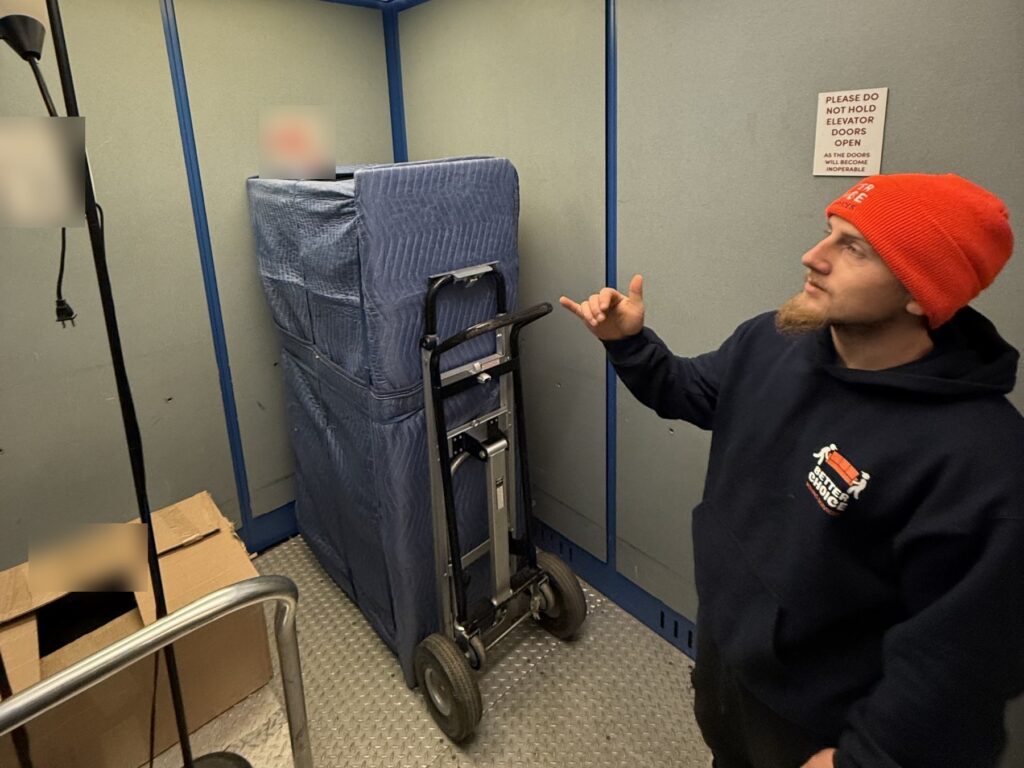
Some of the moves we care about most start with a kitchen table conversation. Mom and Dad have been in the same house in Harleysville, Lansdale or Blue Bell for thirty or forty years. The stairs are getting harder, the yard is a lot, and a friend from church just moved into a 55+ community nearby and loves it. The kids are on speakerphone, everyone agrees it’s time, and then the real question lands: how do we actually do this?
We move families into 55+ communities, independent living apartments and retirement communities across Montgomery County all the time, mostly in the towns we call home: Harleysville, Souderton, Telford, Hatfield, Lansdale, North Wales, Ambler, Blue Bell, Kulpsville, Skippack, Collegeville, Plymouth Meeting and Willow Grove. This guide is everything we’d tell our own family, from what the different kinds of communities really are, to measuring the new floor plan, to the paperwork the community will ask for, to keeping move day calm.
You’re in good company
If it feels like everyone you know is talking about downsizing, the numbers back that up. According to the U.S. Census Bureau’s American Community Survey, Montgomery County had an estimated 163,106 residents age 65 and over in the 2020 to 2024 estimates, about 36,000 more than in the 2010 to 2014 estimates. In several of the townships around our Hatfield office, the share of residents 65 and over is well above the county average.
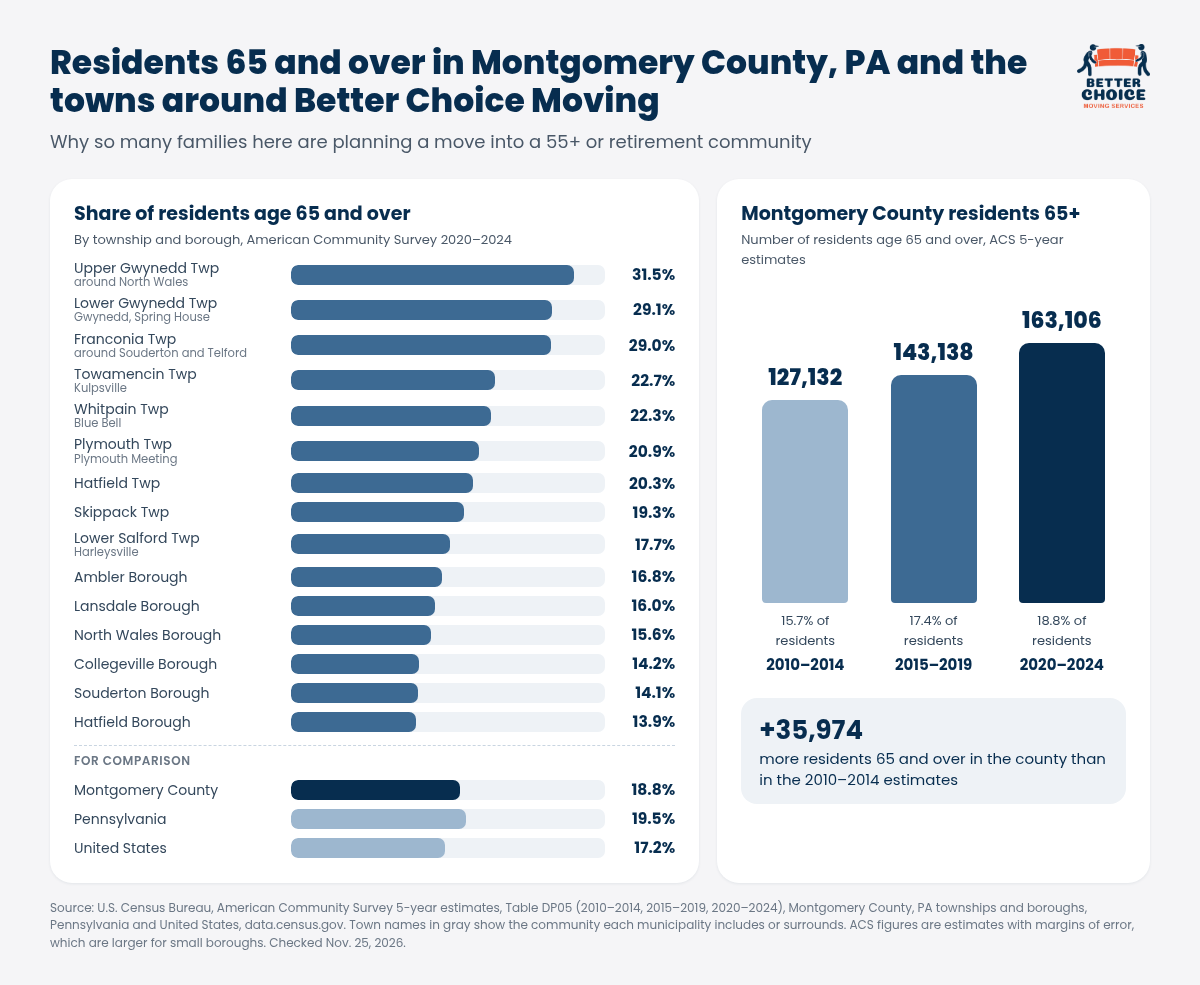
- Some townships skew older. About 31.5% of Upper Gwynedd Township residents (around North Wales), 29.1% in Lower Gwynedd and 29.0% in Franconia Township (around Souderton and Telford) are 65 or older, compared with 18.8% countywide.
- The boroughs skew younger. Lansdale, Souderton, Hatfield and Collegeville boroughs all sit between about 14% and 16%, which matches what we see: younger families buying the houses that longtime owners are leaving.
- The county is getting older over time. The share of Montgomery County residents 65 and over rose from 15.7% to 17.4% to 18.8% across the last three five-year estimates.
That’s a lot of families going through the same decision you are, and a lot of experience in the area to draw on.
55+, independent living, CCRC: what’s the difference?
People use “retirement community” for very different places, and the type of community changes how the move works. Here’s the plain-English version.
55+ (age-restricted) communities
These are neighborhoods of single homes, carriage homes, townhomes or condos built for active adults, usually run by an HOA or condo association. Under federal fair housing rules, a community can operate as housing for older persons when at least 80% of occupied units have at least one resident 55 or older and it publishes and follows its age policies. You own or rent your home like any other, so the move feels like a regular house move with HOA rules on top: truck parking, move hours and sometimes approval paperwork.
Independent living
Usually apartment-style buildings or campuses for older adults, with dining, housekeeping, activities and transportation part of the arrangement. There’s no personal care built in. For movers, these are building moves: elevators, loading docks, long hallways and a set move-in window.
Assisted living and personal care
These communities help with daily activities like bathing, dressing and medications. In Pennsylvania, assisted living residences and personal care homes are licensed by the Department of Human Services. Apartments are smaller, so these moves are usually about choosing a few favorite pieces and setting them up so the room feels like home on the first night.
Continuing care retirement communities (CCRCs or life plan communities)
A CCRC offers independent living with access to higher levels of care on the same campus or by agreement. In Pennsylvania, these are regulated by the Pennsylvania Insurance Department under the Continuing-Care Provider Registration and Disclosure Act of 1984. A provider needs a certificate of authority to offer continuing care and must give you a disclosure statement before you sign or pay. You have seven days after paying the initial deposit or signing to rescind without penalty, and you can’t be required to move in before those seven days are up. The Insurance Department’s CCRC page explains that it regulates the communities that charge large upfront entrance fees, and it has a facility search with disclosure statements. We’re movers, not attorneys, so have your attorney or financial advisor review any agreement. But knowing these protections exist takes some pressure off the timeline.
Start with the floor plan, not the attic
The most common mistake we see is starting with the attic or basement and sorting forty years of things before anyone knows what fits. Start with the new home instead.
- Get the floor plan with dimensions. Most communities have one for every unit or model. Ask for the measured version, including window and door locations, ceiling height in a loft, and where the outlets and cable jacks are.
- Measure your favorite pieces. The recliner, the bed, the dining table and the china cabinet. Write the width, depth and height on a piece of tape on each one.
- Sketch each room. Graph paper and paper cutouts work great, and so does a free online room planner. Leave walking room around the bed and through the living room, especially if a walker or cane is part of the picture now or might be soon.
- Check the way in. Elevator depth, hallway turns and apartment doorways decide what makes it inside. A sofa that came into the house through a wide front door may not turn into a condo hallway. Our post on what to do when furniture won’t fit covers the usual fixes.
- Then decide what comes along. Once the plan is set, everything else sorts into family, donate, sell or store. Our guide to helping a parent downsize walks through that part step by step, so we won’t repeat it here.
A tip from our crews: the things that make a new place feel like home are rarely the big pieces. It’s the quilt on the bed, the photos in the hallway, the clock from the old mantel and the favorite chair by the window. Make sure those come along even if the dining set doesn’t.
What usually fits, and what usually doesn’t
Every floor plan is different, but after a lot of these moves, here’s the pattern we see:
- Usually comes along: the bed (often a queen instead of a king), one sofa or loveseat, a favorite recliner, a small dining table and four chairs, a dresser and nightstands, a TV and stand, a desk, and the art and photos that mean the most.
- Often goes to family or donation: a full formal dining set, the second and third bedroom sets, large sectionals, big entertainment centers, and duplicates of everyday kitchen things.
- Often goes to storage for a while: pieces the kids want but can’t take yet, seasonal decorations, and heirlooms the family hasn’t decided on. There’s no rule that every decision has to happen before move day.
- Can’t go on the truck: paint, propane, gasoline and other hazardous items. Here’s our list of what movers won’t move so nothing surprises you.
Ask the community these questions before you pick a date
Every community has its own move-in rules, and they’re easy to miss in a welcome packet. A quick call to the property manager or HOA answers most of them. Here’s our list:
- Do you need a certificate of insurance (COI) from the mover? Most buildings and many HOAs do, often with specific wording or additional insureds. Send us the requirements and we’ll get the certificate to the manager ahead of time. Our guide to COIs and elevator reservations explains what they typically ask for.
- What are the move-in days and hours? Some communities don’t allow moves on weekends or holidays, and many set a window, like weekday mornings, so moves don’t run into dinner service.
- Is there an elevator or loading dock to reserve? Ask how long the reservation lasts, whether elevator pads are provided, and who has the key to put the elevator on hold.
- Where can the truck park? A main entrance canopy, a side door, a loading area or the street. Distance from the truck to the door makes a big difference in how the day runs.
- Is there HOA or management approval paperwork? In 55+ HOA communities, ask what has to be approved or filed before move-in, and how long it takes.
- Can we get in early? If the community allows a visit before the move, measure, take photos of the outlets and the cable jack, and decide where the bed goes.
- Who hangs pictures and mounts the TV? Some communities have maintenance staff who do this, or rules about wall anchors. Good to know before the hammer comes out.
When you plan your move with us, we go through these questions with you and note the answers on your reservation, so the crew shows up already knowing where to park, which elevator to use and when the building expects you.
Timing the sale and the move
The hardest part of many senior moves isn’t the packing. It’s the calendar. The new apartment opens on one date, the house goes on the market on another, and the closing lands somewhere else. Three ways families usually handle it:
- Move first, then sell. If the community has the apartment ready, moving first lets you list an empty, staged or lightly furnished house, and nobody has to keep it show-ready while living in it.
- Sell first, then move. If you need the proceeds before you move, plan the closing for a few days after the move-in date, not the same day.
- Store in between. When the dates just won’t line up, our moving and storage service picks up the house, keeps your things in storage vaults at our Quakertown warehouse at 420 Station Rd, and delivers to the new community when it’s ready. It’s the same company on both ends, with no third party in between. Our closing-date gap guide explains how it works.
Storage also helps with the “not yet” pile. If the kids need a few months to pick up Grandma’s hutch, or the family hasn’t decided about the piano, those pieces can wait in a vault instead of crowding the new apartment.
Move day, made easy for Mom and Dad
A move after forty years in one house is emotional, even when everyone is excited about the new place. A few things make the day gentler:
- Plan where Mom and Dad will be. Some parents want to be in the middle of it. Others are happier at the new community, or having lunch with a friend, and walking in once the bed is set up. Either is fine. Just decide ahead of time.
- Pack a first-night bag. Medications, glasses, hearing aid batteries, phone chargers, a change of clothes, toiletries, important papers and the TV remote. This bag rides in the car, not the truck.
- Set up the bedroom first. We place the bed, make sure there’s a clear path to the bathroom, and set up lamps so the first night isn’t spent hunting for a light switch.
- Put the familiar things out right away. The favorite chair in its spot, photos on the dresser, the coffee maker on the counter. It makes the new place feel like theirs on day one.
- Have one family member at each end if you can. One person to say goodbye to the house and do the final walkthrough, and one person at the new community to direct where things go.
- Protect the old house and the new one. Our crews pad doorways and lay floor runners, and in community buildings we protect elevators and shared hallways too. Here’s how we protect floors and stairs.
Our senior moving service is built around days like this one, with crews who move at the family’s pace and take the time to put things where they belong.
A note for the adult kids
If you’re the son or daughter coordinating this from out of town, or from twenty minutes away between work and your own kids, you’re not alone. A lot of the calls we get for these moves come from adult children. A few things that help: pick one family member to be the main contact for the community and the movers, keep a shared list of who is taking which pieces, and give your parents real choices about the things that matter to them. The move goes better when it feels like their decision, not something happening to them.
Where we see these moves around Montgomery County
Our main office is at 7 Church Rd in Hatfield, so most of these moves are close to home: from a longtime house in Harleysville, Souderton, Telford or Kulpsville to a 55+ community or retirement campus nearby, or from Blue Bell, Ambler, North Wales and Plymouth Meeting into an apartment-style community where the elevator schedule sets the day. Our pages for Hatfield movers, Lansdale movers, Harleysville movers and Blue Bell movers show more of the neighborhoods we work in, and our Montgomery County movers page covers the rest of the county. Planning a move to the Bucks County side instead? Our Doylestown guide covers that area.
Frequently asked questions
What is the difference between a 55+ community and independent living?
A 55+ community is usually a neighborhood of homes, townhomes or condos that you buy or rent, governed by an HOA, condo association or owner, and operated under the federal “housing for older persons” rules. You live there as a regular homeowner or tenant, and most services are up to you. Independent living is typically an apartment-style community for older adults with extras like meals, housekeeping, activities and transportation built into the monthly arrangement. Neither one provides personal care or nursing by itself. Assisted living and personal care homes do, and in Pennsylvania those are licensed by the Department of Human Services.
Can someone under 55 live in a 55+ community?
It depends on the community. Under the federal Housing for Older Persons rules, at least 80% of occupied units must have at least one resident who is 55 or older, and the community has to publish and follow its age policies. Each community decides how to handle the rest, so some allow a younger spouse or partner and others are stricter about adult children or long visits. Read the HOA or community documents, or ask the manager, before you plan who is moving in.
Are continuing care retirement communities regulated in Pennsylvania?
Yes. Under Pennsylvania’s Continuing-Care Provider Registration and Disclosure Act, a provider needs a certificate of authority from the Pennsylvania Insurance Department to offer continuing care, and it must give you a disclosure statement before you sign or hand over money. You can rescind the agreement without penalty within seven days of paying the initial deposit or signing, and you can’t be required to move in before that period ends. The Insurance Department notes that it regulates the communities that charge large upfront entrance fees, and it keeps an online facility search.
How far ahead should we book movers for a move into a retirement community?
As soon as the community gives you a move-in window. Many buildings schedule elevator time and loading dock access in advance, and the end of the month is busy for closings and move-ins alike. Booking early gives you your choice of dates, time to collect the certificate of insurance and HOA approvals, and room to plan around the sale of the house.
What should you not bring when moving into a 55+ or senior living community?
Leave behind anything that doesn’t have a spot on the new floor plan: duplicate furniture, oversized pieces, extra dishes and linens, and most of the garage and basement. Many families also skip loose throw rugs, which can be a tripping hazard. Paint, propane tanks, gasoline and other hazardous items can’t go on a moving truck, so plan to use them up or dispose of them before move day.
We’d be honored to help with this move
If your family is getting ready for a move into a 55+ or retirement community, call us and tell us about the house, the new community and the dates you’re working with. We’ll walk through the floor plan and the community’s rules with you and build the day around your parents, not the other way around. Better Choice Moving is a family-owned mover, fully licensed and insured (PA PUC A-2024-3049983, USDOT 4168676), with our main office at 7 Church Rd in Hatfield and vault storage in Quakertown. Call us at (215) 622-8140, plan your move with us, or reserve your move online.
About the chart and sources: age figures are from the U.S. Census Bureau’s American Community Survey 5-year estimates, Table DP05 for Montgomery County townships and boroughs (2020 to 2024), with county, Pennsylvania and U.S. comparisons and the county’s 2010 to 2014 and 2015 to 2019 estimates from the same table. ACS figures are estimates with margins of error, which are larger for small boroughs. Town names under each municipality are for orientation (for example, Harleysville is mostly in Lower Salford Township and Kulpsville is in Towamencin Township). CCRC rules are from Pennsylvania’s Continuing-Care Provider Registration and Disclosure Act and the Pennsylvania Insurance Department, and 55+ housing rules are from 24 CFR Part 100, Subpart E. All checked Nov. 25, 2026. This guide is general information, not legal or financial advice.