

When families call us, the first question is almost always “Are you open on the 30th?” It’s a fair question, because a lot of the time the date picks itself: the closing is set, the lease ends, school starts. But when you do have some say, the month and even the day of the week you choose can make the whole move easier on you, your house and your things.
We move families around Montgomery, Bucks, Chester and Lehigh counties all year, in July heat and January sleet. Here’s how we’d help a friend think through the calendar, with 30 years of local weather data to back it up.
What the weather data says
We pulled NOAA’s official 1991–2020 climate normals for Lehigh Valley International Airport, the long-record weather station closest to the middle of our service area, and calculated daylight for each month. Towns closer to Philadelphia tend to run a little milder, but the pattern is the same across our four counties.
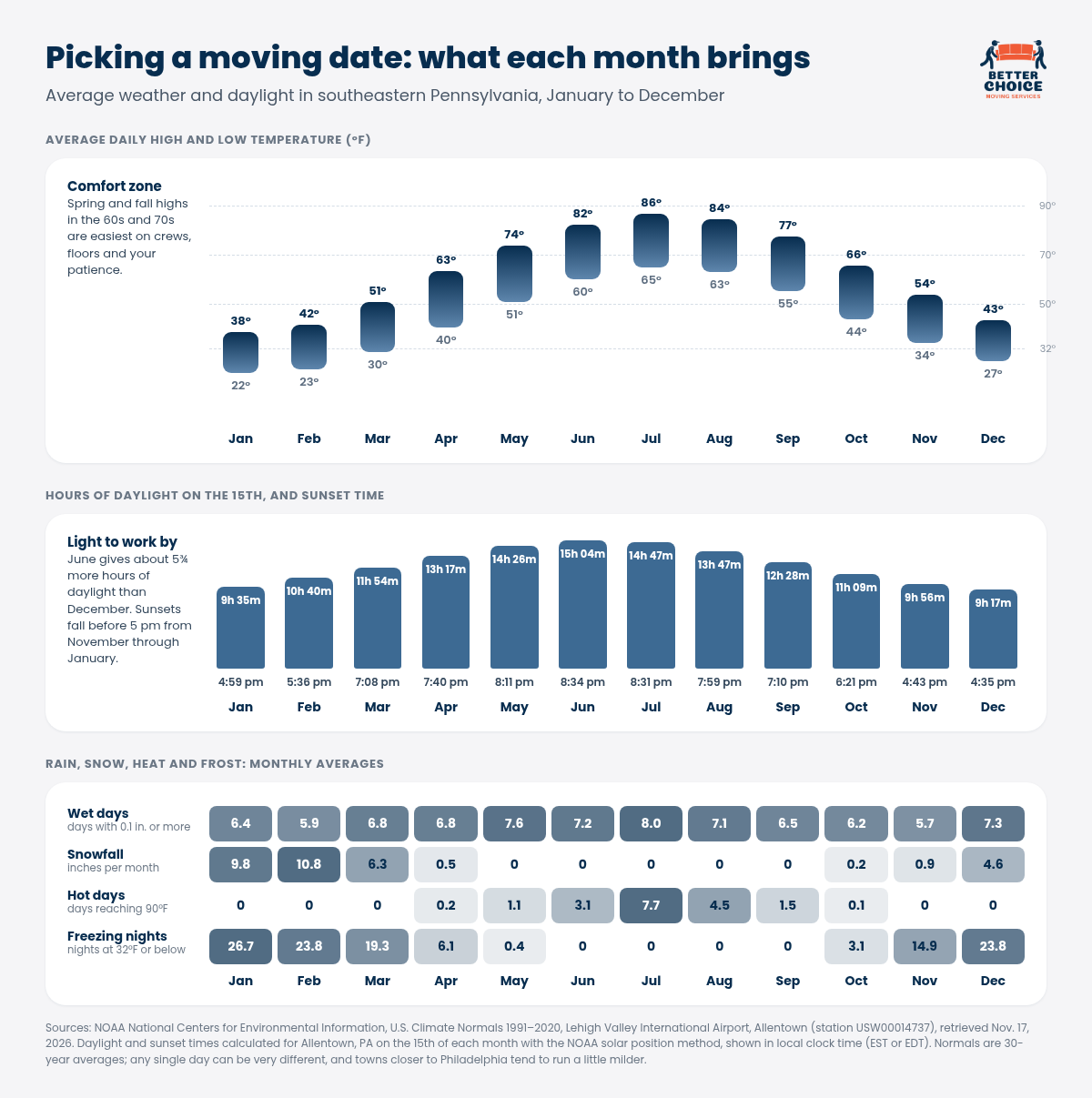
A few things jump out:
- Rain doesn’t take a season off. Every month averages between about 6 and 8 days with a tenth of an inch of rain or more. July is actually the wettest by that count, thanks to summer thunderstorms. So whatever month you pick, plan as if it might rain. (It’s why our crews put down floor runners and door pads on every move, and why we wrote a whole guide on protecting floors and stairs on moving day.)
- Snow is mostly a December-to-March thing. January and February average about 10 to 11 inches each, March about 6, and December between 4 and 5. November and April barely register.
- Heat is a short window. Days reaching 90°F average about 8 in July and about 4 or 5 in August, and only a handful in June and September.
- Daylight swings a lot. Mid-June has almost six more hours of daylight than mid-December, and sunsets come before 5 pm from November through January.
The calendar, season by season
Late April through early June
Highs in the 60s and 70s, long days, no snow and very few hot ones. For the work itself, this is about as good as it gets. It’s also when a lot of houses go under contract, so if you’re planning a spring move, it pays to get your estimate on the books early, before your closing date is even final.
Mid-June through August
Summer is the classic moving season because school is out, and that convenience is worth a lot for families with kids. The tradeoffs are heat, humidity and afternoon storms. A few things help: ask for an early start so the heavy lifting happens before the hottest part of the day, keep the air conditioning running in both homes if you can, and set out water for everyone, crew included. Things like candles, vinyl records, photos and some medications don’t love a hot truck or a hot car, so plan to carry the sensitive stuff with you.
September and October
Our favorite stretch, honestly. Highs drop from the high 70s into the mid 60s, September averages only about 1 or 2 days at 90°F, and there’s still plenty of light: mid-September sunsets are around 7:10 pm, and mid-October’s are still after 6. Once school starts, many families find weekday dates opening up, too. If you’re downsizing or moving a parent and the date is flexible, early fall is a lovely time to do it. Our guide to helping a parent downsize walks through the planning.
November through March
Cooler months bring short days, freezing nights and, from December on, a real chance of snow. November averages about 15 freezing nights, and mid-December has just over 9 hours of daylight. That doesn’t make winter a bad time to move. It just means planning matters more: start early in the day, clear and salt walkways the night before, and keep a backup date in mind if a storm is in the forecast. Our winter moving tips cover the details. One thing to know about March: daylight saving time starts the second Sunday (March 14 in 2027), and suddenly there’s sun until after 7 pm.
Picking the day, not just the month
- Mid-month and midweek give you the most choice. Closings and lease turnovers tend to bunch up at the end of the month and on Fridays, and so do moving requests. If you can choose, a Tuesday or Wednesday in the middle of the month usually means more arrival times to pick from.
- Leave a cushion around your closing. Closing dates can slip a day or two. If you’re buying, a move date the day after closing gives you breathing room if the paperwork runs long.
- Check the building’s rules. Condos, townhome communities and apartments often limit moves to certain days and hours and want the elevator reserved and a certificate of insurance on file. Our guide to apartment and townhome moves explains what to ask.
- Think about the first night. With kids or pets, a morning move gives you daylight to set up beds and find the essentials before dinner. Here’s our first-night plan.
- Count backward. Once you have a date, work back from it so packing, address changes and utilities all land in time. Our move preparation guide and address-change checklist help with the timeline.
When the dates won’t line up
Sometimes the perfect move date for the old house is the wrong one for the new house. You close on your sale in May, but the new place isn’t ready until July. Or the buyers want to be in before school starts and you haven’t found your next home yet. That’s exactly what our move-and-store service is for. We load your things, keep them in vault storage at our Quakertown warehouse at 420 Station Rd, and deliver them when you have the keys. That way you can pick the best date for each move instead of forcing both into one day. Our closing-date gap guide explains how it works.
Talk it through with us
If you’re weighing a couple of dates, we’re happy to help you think it through, even if you’re months out. Better Choice Moving is a family-owned mover at 7 Church Rd in Hatfield, serving families across Montgomery, Bucks, Chester and Lehigh counties. Call us at (215) 622-8140, schedule an estimate, or book your move online.
About the chart: temperatures, precipitation days, snowfall, hot days and freezing nights are NOAA National Centers for Environmental Information U.S. Climate Normals for 1991–2020 at Lehigh Valley International Airport (station USW00014737), retrieved Nov. 17, 2026. Daylight and sunset times are calculated for Allentown, PA on the 15th of each month using the NOAA solar position method, in local clock time. Normals are 30-year averages, so any single day can be very different; check the forecast as your date gets close.