
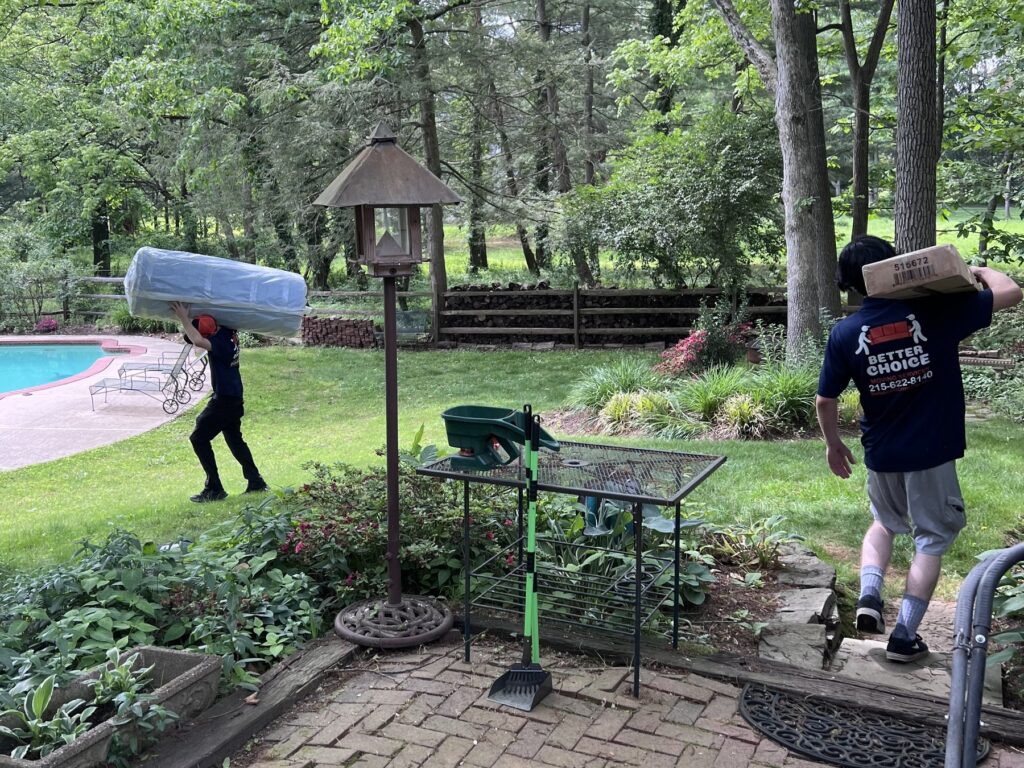
Most moving checklists stop at the front door. But if you live in Montgomery, Bucks, Chester or Lehigh County, there’s one more thing worth a few minutes of your time before moving day: a quick look at everything that lives outside. The patio set, the grill, the kids’ bikes, the plant pots by the back steps.
The reason is the spotted lanternfly. All four of our counties sit inside Pennsylvania’s spotted lanternfly quarantine, and the insect’s egg masses love exactly the kind of things that get loaded onto a moving truck last. Here’s what to look for, when to look, and how to handle it without turning moving week upside down.
Why it matters on a move
The Pennsylvania Department of Agriculture (PDA) quarantines counties where the spotted lanternfly is established. According to the PDA’s 2025 quarantine map, that’s 56 of the state’s 67 counties, including every county we serve. The quarantine prohibits moving any living stage of the insect, including egg masses, and it specifically names outdoor household items such as grills, outdoor furniture and their covers, tarps, mowers and mobile fire pits, along with firewood and vehicles or equipment that aren’t stored indoors.
A move is one of the few times a household packs up all of those things and drives them somewhere new. Moving within the quarantine area still calls for a look, and if you’re headed somewhere the insect hasn’t reached yet, it matters even more. Nobody wants to bring an invasive pest to their new neighborhood along with the patio chairs.
What to look for, month by month
The spotted lanternfly has one generation a year in Pennsylvania. The PDA’s own checklist lays out when each life stage shows up, and when you line those months up, one thing becomes clear: there’s no month off.
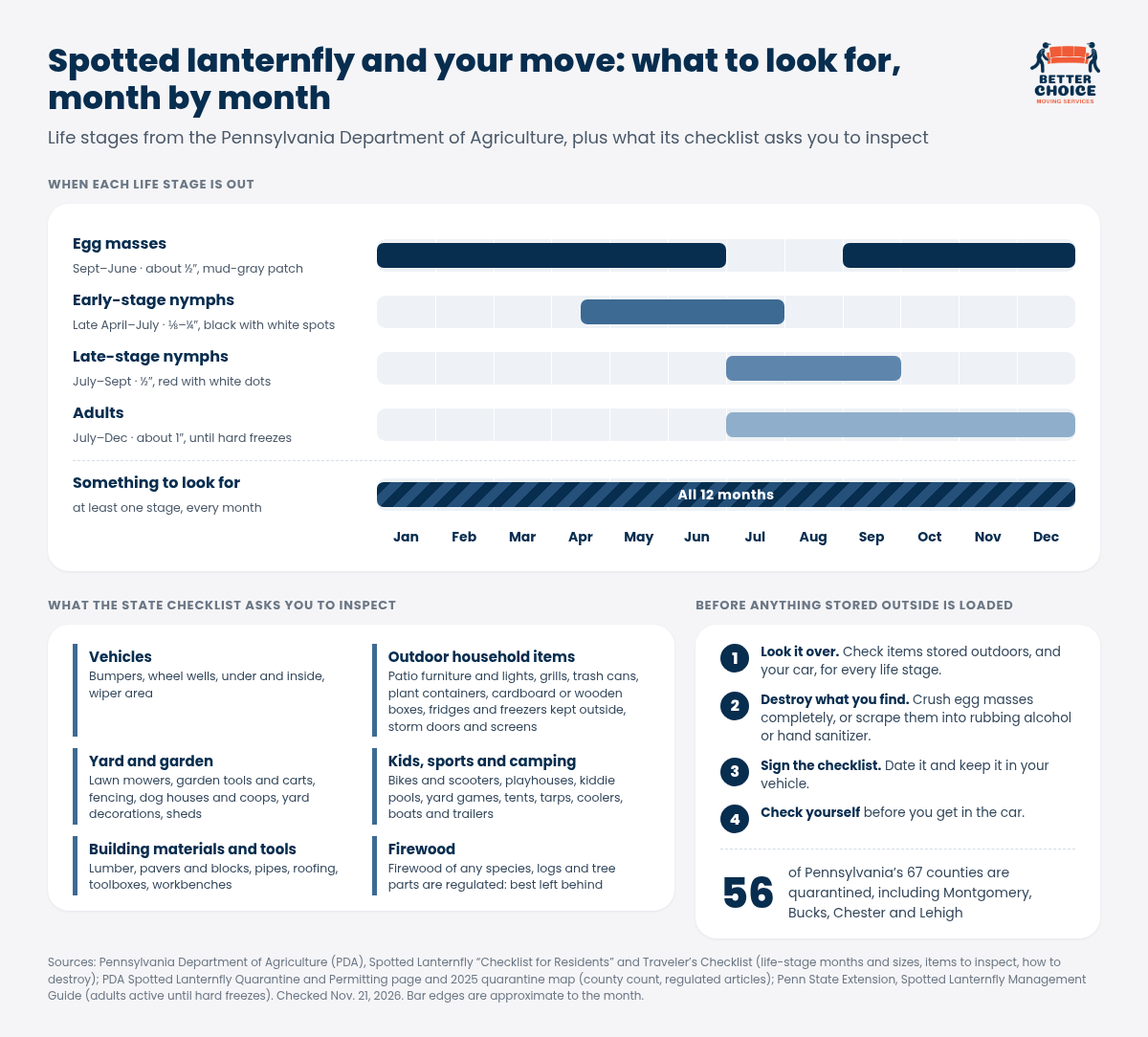
- Fall through spring (September to June): egg masses. This is the stage most people miss. Penn State Extension says eggs are laid in the fall and hatch from late April into June. An egg mass is a flat patch, roughly half an inch to two inches long, protected by a gray, mud-like covering that weathers and cracks as it ages. Each one holds about 35 eggs, so one patch under a patio table is a lot more than it looks.
- Late April to July: early-stage nymphs. Tiny (an eighth to a quarter of an inch), black with white spots, and easy to mistake for a tick or a spider.
- July to September: late-stage nymphs. About half an inch, red with white dots and black stripes.
- July to December: adults. About an inch long, with gray forewings marked by black spots, and they stay active until hard freezes. They’re the easiest stage to spot because they’re big and they jump.
So if you’re moving between now and early summer, the thing to look for is egg masses. In summer and fall, it’s the nymphs and adults that hitch rides.
Where egg masses hide
Egg masses can be laid on almost any flat, sheltered surface: tree bark, decks, siding, outdoor equipment, even rocks. The state’s “Checklist for Residents” groups the things to check like this:
- Outdoor household items: patio furniture and lights, grills, trash cans, plant containers, cardboard or wooden boxes, refrigerators and freezers kept outside, shutters, storm and screen doors.
- Yard and garden: lawn mowers, garden tools and carts, fencing, dog houses and coops, yard decorations.
- Kids’ things, sports and camping: bikes and scooters, playhouses, kiddie pools, yard games, tents, tarps, coolers, boats and trailers.
- Building materials and tools: lumber, pavers and blocks, pipes, roofing, toolboxes, workbenches.
- Your vehicle: bumpers, wheel wells, under and inside the car, and around the windshield wipers.
Look underneath, not just on top. Table undersides, the inside of grill lids, the back of a planter, the folds of a furniture cover and the underside of a wheelbarrow are classic spots.
A simple plan for moving week
- Gather the outdoor things a few days early. Pull patio furniture, planters, toys and yard tools into one spot, like the garage or a corner of the driveway. It makes the inspection quick and makes loading smoother.
- Check each piece in daylight. Use the state checklist as your guide. A flashlight helps with undersides and grill interiors.
- Destroy what you find. The PDA says to crush egg masses completely, or scrape them off (a plastic card or putty knife works) into a bag or container with rubbing alcohol or hand sanitizer. The same goes for nymphs and adults.
- Clean before you wrap. Once outdoor furniture is checked and wiped down, it’s ready to be padded and loaded. Wrapping something first and checking later just means unwrapping it again.
- Sign the checklist and keep it in your car. The PDA asks residents to sign and date the “Checklist for Residents” and keep it in their vehicle as a record that they inspected what they’re moving.
- Check yourself before you drive off. In summer especially, adults and nymphs can land on clothes and bags. Penn State Extension also suggests keeping car windows rolled up when you park during the warm months, and not parking or staging things under infested trees.
A few things to leave behind
Firewood. Firewood of any species, logs and tree parts are regulated under the quarantine, and they’re one of the easiest ways to move pests of all kinds. A stacked woodpile is also a favorite egg-laying spot. The simplest answer is to burn it down before the move, offer it to a neighbor or leave it for the buyers if they want it.
Propane tanks and fuel. These are on the list of things movers can’t put on the truck anyway. Our guide to items movers won’t move covers what to do with them.
Things you don’t love. If the cracked planters and the rusty patio set weren’t coming to the new house in your heart anyway, this is a good moment to let them go. Our post on furniture that won’t fit the new house has ideas for donating, storing or hauling away.
Moving out of state or into storage
If you’re moving out of state from Pennsylvania, take a look at the destination state’s department of agriculture website before moving day. Some states run their own spotted lanternfly programs, and every state appreciates not getting a new one.
And if there’s a gap between your closing dates, the same habit applies to anything headed into storage. With our move-and-store service, your belongings go into vault storage at our Quakertown warehouse at 420 Station Rd until you have the keys to the new place. Checking the outdoor pieces before they’re loaded means you’re storing only what you meant to. Our closing-date gap guide explains how move-and-store works.
We’re glad to help you plan it
When you make your reservation, mention the patio set, the shed and anything else that lives outside so we can plan time for it on moving day. Better Choice Moving is a family-owned, fully licensed and insured mover (PA PUC A-2024-3049983, USDOT 4168676) at 7 Church Rd in Hatfield, serving families across Montgomery, Bucks, Chester and Lehigh counties. Call us at (215) 622-8140, plan your move with us, or reserve your move online.
About the chart and sources: life-stage months and sizes, the items to inspect and how to destroy egg masses are from the Pennsylvania Department of Agriculture’s Spotted Lanternfly Checklist for Residents and its homeowner guidance. The county count and regulated items are from the PDA’s Spotted Lanternfly Quarantine and Permitting page and 2025 quarantine map. Egg-laying and hatch timing, egg counts and adult activity are from Penn State Extension’s Spotted Lanternfly Management Guide. All checked Nov. 21, 2026. Quarantine boundaries can change, so check the PDA’s interactive map for the latest.